
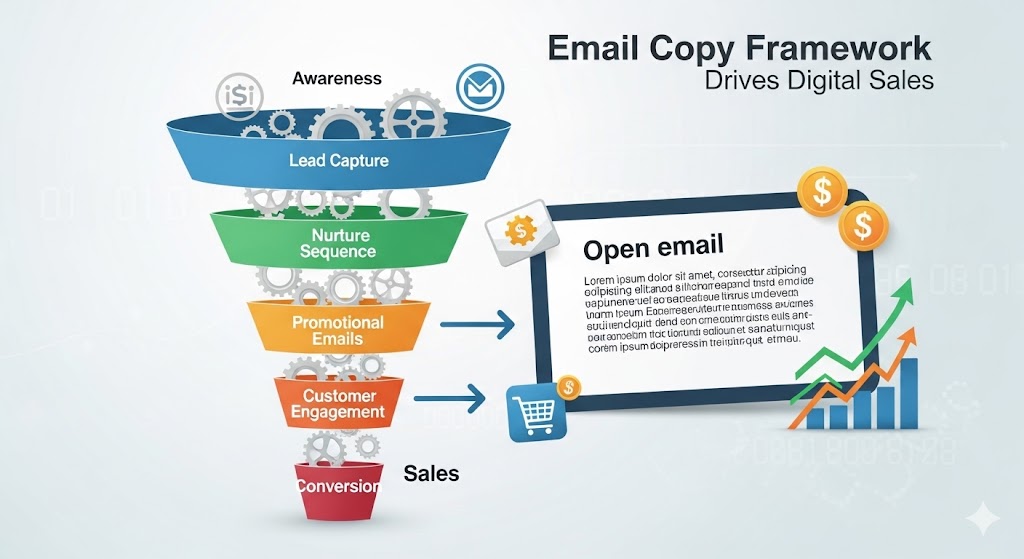
Email is one of the channels that sell digital products to this day, as it forms a direct link based on trust with your audience. Sending random promotional messages won’t cut it. It stems from the use of structured frameworks that lead readers to take action. Powerful email marketing copy, when executed correctly, increases engagement, establishes authority, and ramp up email sales conversion rates.
So what are frameworks, and how do they work? Attraction and intrigue that makes your message land strong instead of throwing mud to see what sticks. Instead of attempting to calculate the right thing to say, you follow a proven framework that matches how people think and buy. This is crucial during a product launch when every email in your email launch sequence should be driving the reader closer to purchasing.
The PAS framework is one of the most powerful frameworks for digital sales. You use the AIDA (Attention, Interest, Desire, Action) model: You start with a pain point for your audience, followed by agitating it.” And finally you offer your product as the solution.
It works for the simple reason that it puts a connection with your audience before you try to sell them anything. Emotion is the driving force behind action in email marketing copy. When the problem is acutely felt by readers, your offer feels like its natural solution, and email sales conversion improves.
AIDA, which stands for Attention, Interest, Desire, and Action. First, you grab attention with a killer subject line. Share an insight or a benefit that they can relate to, to generate interest. Then you create desire by demonstrating transformation or results. Finally, you have a clear call to action where you request action.
This framework works really well for promo emails in an email launch sequence. It reflects the customer’s buying journey, which helps keep your message relevant and persuasive.
Stories resonate with people better than a sales pitch. The story, lesson, offer — This framework begins with a narrative about you, your client, or your situation that addresses the concern in general, and ends by detailing your proposal as the next logical step.
Email marketing copy based on a story builds trust and authenticity. It allows readers to picture themselves in the scenario, which lowers resistance and improves email sales conversion without coming across as pushy.
Not all emails should sell hard. This framework centres on providing value first. In the first part of the email, you provide value in the form of tips, insights or a strategy. Repeat with even more value and then softly present your product.
This is a great way to warm people up in advance of an email launch sequence, or while the email launch sequence itself is happening. By giving value consistently, readers become more accepting of you making an offer.
There is no singular framework that works for an email launch sequence, but rather a combination of many. Early emails might be centered around value and storytelling to establish trust. The offer is usually introduced in the middle emails using PAS or AIDA. Last-ditch emails stress urgency, reminders and reassurance.
Consistency is key. So use simple words, shout your biggest benefit, and include a strong CTA every time. Keep in mind that very few people will purchase from the first email they read; it may take multiple views of your message before they decide to buy.
Clarity, structure, and trust underpin strong digital sales. Learn how to write dry-ass email marketing copy with proven frameworks and what an ideal email launch sequence looks like so that it doesn’t come across as forced. If every email serves as a clear path forward, selling is ultimately a matter of guidance — not coercion.

Simply browse our curated library of digital courses, eBooks, and videos, choose what fits your needs, and complete your purchase using our secure checkout
Explore our library of courses, eBooks, and videos.
Securely pay with your card or PayPal
Get instant access and start learning right away.
We believe that the right digital content can transform ideas into action. Whether you’re scaling a business, building new skills, we’re here to fuel your journey.